.svg "Zivid")




Zivid didn't have a booth at MODEX 2026 — but our cameras were working overtime on the show floor. Four of our partners chose to run live demos powered by Zivid 3D vision, covering everything from depalletizing heavy cardboard boxes to picking transparent plastic-wrapped items. Here's what was running, and why it matters.
Zivid demos
OSARO — palletizing and depalletizing
OSARO built their AI to handle the variability that makes robotic picking hard: mixed SKUs, reflective packaging, inconsistent stacking, variable lighting. Zivid 3 feeds it what it needs — high-definition 2D and 3D data in under 500ms, even on surfaces that trip up most vision systems. The result: A mixed-case depalletizing into an automated pack-out demo, running live on the floor.
Camera used: Zivid 3 XL250
AWL — parcel handling with the ROSI cell
AWL demonstrated their ROSI cell, a flexible automated workcell built for logistics operations where parcel shape, size, and label orientation vary. Consistent 3D data across that variability is what keeps throughput predictable.
Camera used: Zivid 2+ M130
CMES — mixed-SKU piece picking
CMES showed piece picking across a wide mix of SKUs — colorful packaging, transparent film wrap, plain cardboard — and placing items onto a conveyor belt. The breadth of the SKU mix is the point: the camera handles them all without per-product tuning.
Camera used: Zivid 2+ MR130
Nomagic — e-commerce piece picking
Nomagic demonstrated a piece-picking robotic cell with two large bins, picking a wide variety of items typical of e-commerce fulfillment — totes, boxes, and more with physical AI. When picking tasks involve highly variable objects in unpredictable arrangements, the quality of the 3D input shapes what the AI can reason about — you can't infer grasp geometry from an incomplete point cloud.
Camera used: Zivid 2+ MR130
What these four demos have in common
Each application puts different demands on a 3D camera. Together, they cover the range of challenges that make vision-guided picking hard in practice: flat, textureless surfaces; reflective and transparent materials; cluttered bins; mixed SKUs. Partners don't show demos that don't work. When four different companies with four different software stacks each choose to run live applications at a major trade show, they're making a public statement about the reliability of the underlying technology.

We set the 3D standard for Quality of Data through innovation
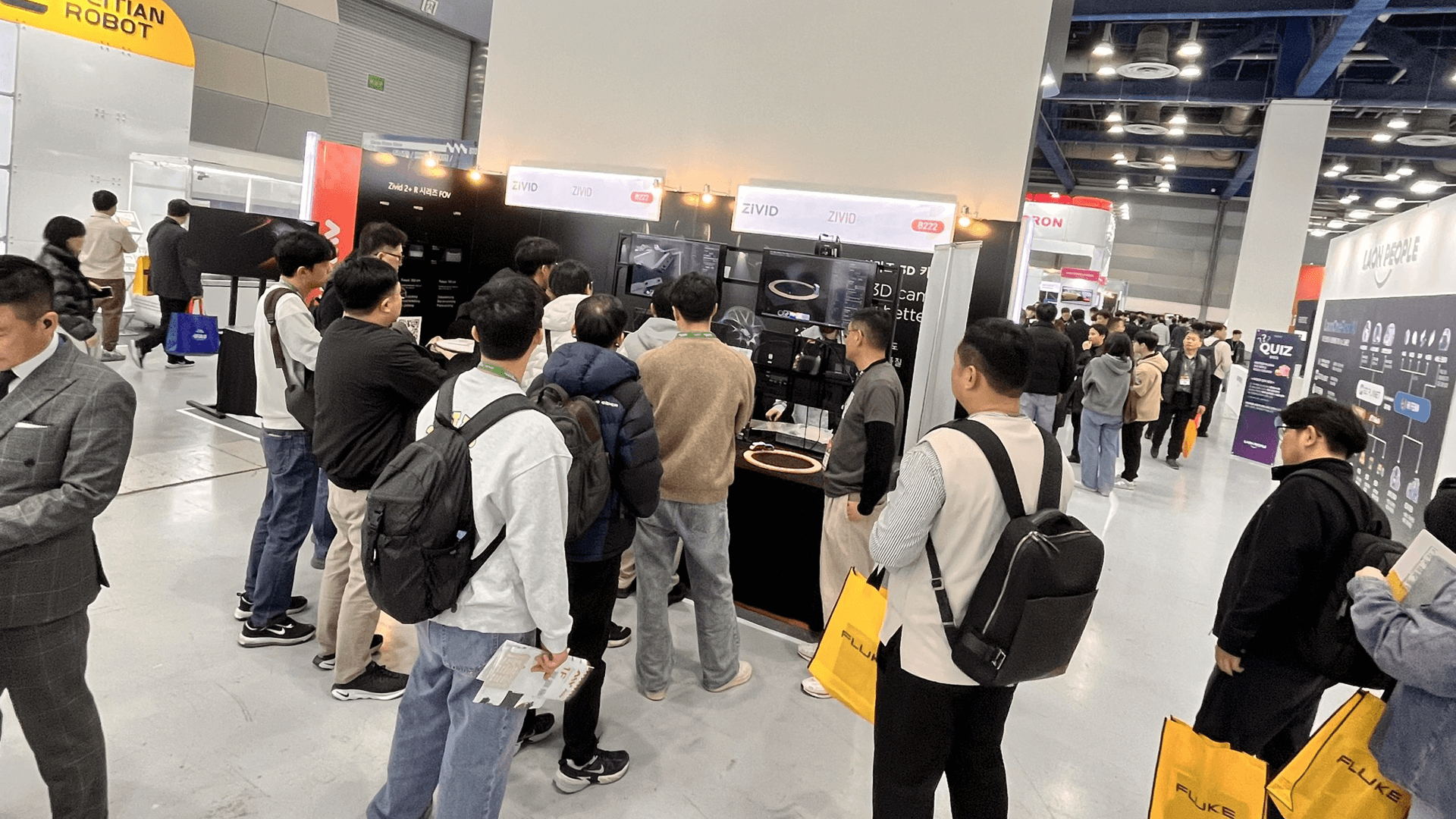
Showcasing Zivid's Industrial 3D Camera Solutions at the Korea Vision Show (AW2025)