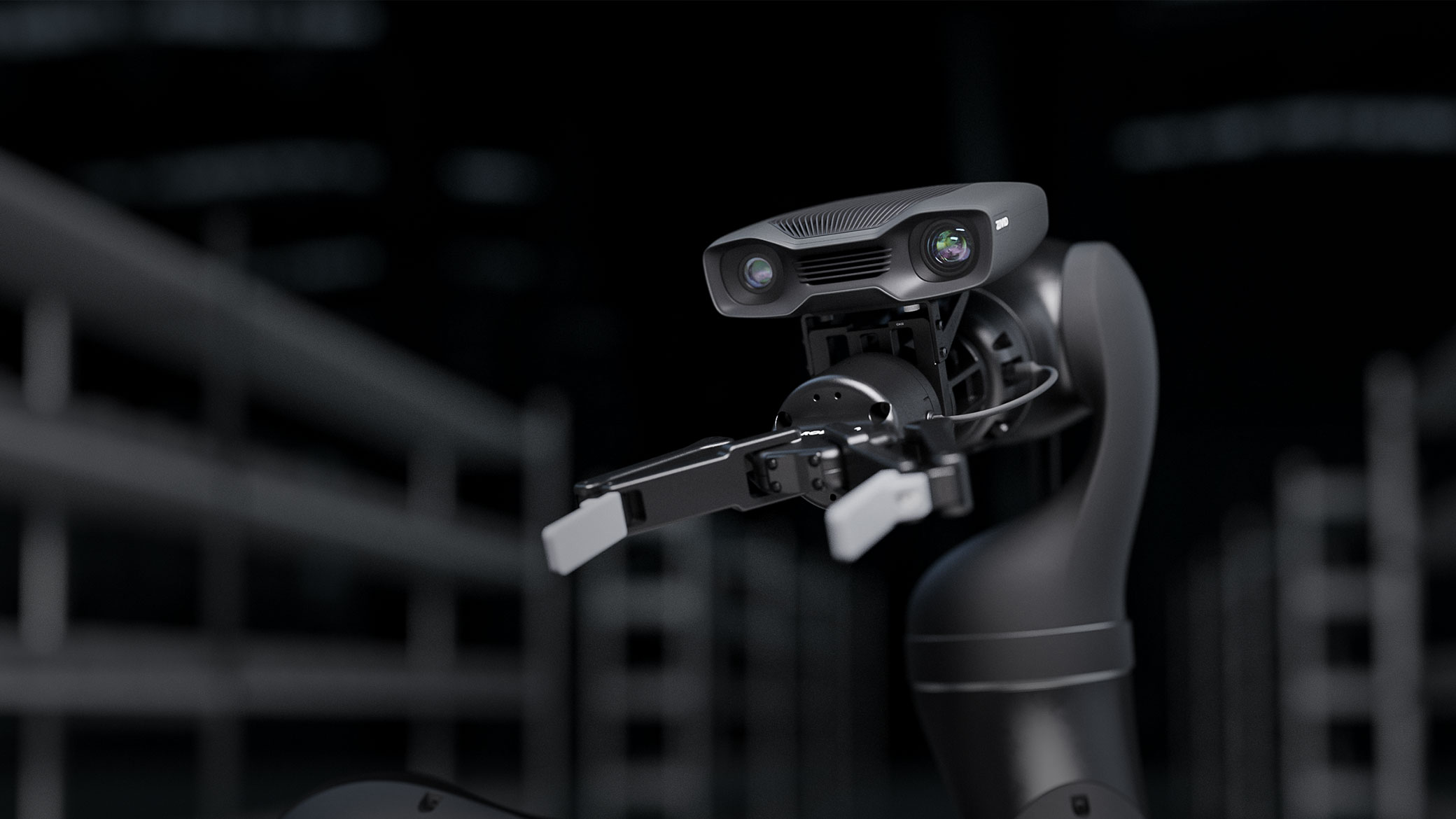

When a 3D camera reports the size and position of objects true to reality, a motion planner can trust the clearance it sees instead of padding every obstacle with a safety margin. Smaller margins allow tighter, shorter robot paths, which means faster cycles with fewer stops.
Watch a picking cell that was commissioned conservatively, and you will see it. The robot lifts every item well clear of the tote wall before it moves, approaches the last items in the bin at a cautious vertical angle, and sometimes gives up on parts sitting in the corners. The cell is simply paying for uncertainty it cannot see.
That uncertainty usually starts in the 3D data. This blog follows the chain from camera to cycle time, one link at a time, and shows where Zivid 3 and Zivid 2+ R‑series cameras and Zivid Motion fit in.
The vision-to-motion chain in four links
Motion planning is the software step that computes a collision-free path for the robot between two poses. Its output can only be as good as the map of the world it plans in, and that map comes from the 3D camera.
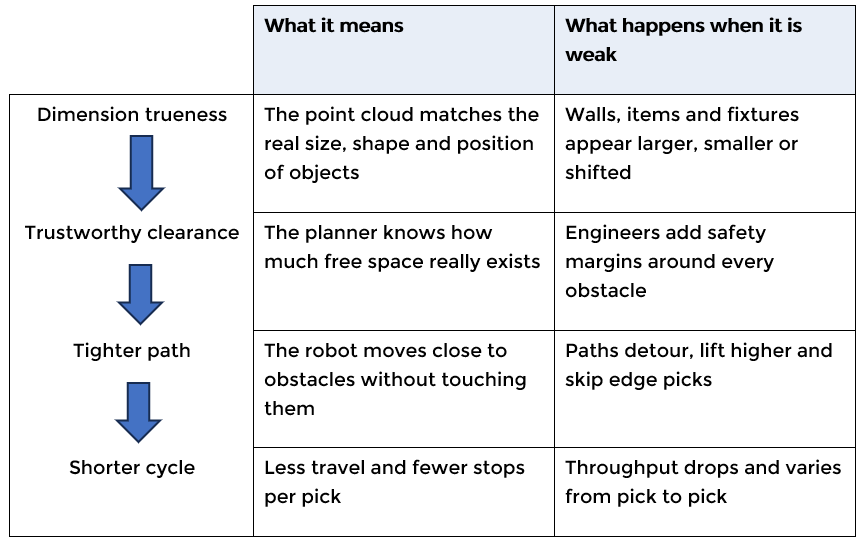
Each link depends on the one before it. A fast planner cannot recover clearance that the camera data never established.
Why dimension trueness matters for collision checking
Zivid defines trueness as the systematic deviation between measured 3D data and the true physical geometry, covering errors in size, shape, position, and orientation. It is different from point precision, which describes how much a single point varies from one capture to the next. A camera can be very repeatable and still be consistently wrong.
Dimension trueness error is the 70th percentile dimension error across the field of view, stated as a percentage of object size. In Zivid's own illustration, a 0.2% error means a 100 mm part may measure up to 0.2 mm off, and a 300 mm part up to 0.6 mm.
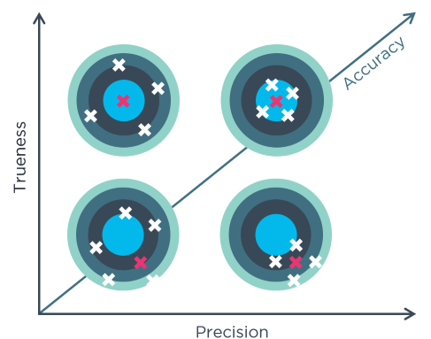
Learn more about the difference between trueness, precision and accuracy →
For collision checking, systematic error is the one that hurts. If the camera places a tote wall a few millimetres away from where it really stands, the planner will either cut too close or must be told to keep its distance everywhere. The Zivid 2+ MR60 is specified at over 99.8% trueness, and the MR130 and LR110 at over 99.65%. All R-series cameras are factory calibrated and keep full 3D calibration performance from 0 to 45 °C, so the number holds in any extreme temperature changes within this range. For larger working volumes, the Zivid 3 XL250 is specified at over 99.85% trueness at its 2.5 m focus distance and uses thermal stabilization to stay stable through temperature swings.
Zivid Motion dynamically incorporates the grasped object into the robot’s collision model for safer, more precise manipulation.
How measurement error turns into safety margin
A motion planner builds its collision model from the data it is given. Zivid Motion, for example, builds collision models from CAD files, meshes, and point clouds. When engineers cannot trust that data, they compensate the only way they can: by inflating obstacles.
Safety margins tend to stack up in three places:
- The environment. Bin walls, pallets, and fixtures get a buffer to absorb measurement error.
- The object in hand. If the grasped item's measured size is uncertain, the planner must assume it is bigger, so the robot lifts it higher before moving sideways.
- Missing data. Gaps in the point cloud leave the planner unsure whether a space is free, which results in crashes.
A safety margin is really a guess about error. True-to-reality data turns that guess into a small, known number, and the margin can shrink to match. The R-series uses 3D HDR to capture shiny surfaces, transparent plastics, and black parts, and the Zivid 3 XL250 is built to capture black, shiny, and transparent objects such as metal parts, glossy packaging, and wrapped water bottles. Both help fill those gaps in the first place.
Where a tighter path shows up in cycle time
Once clearance can be trusted, the gains appear in specific moves:
- Exit paths. The robot lifts an item only as high as the real clearance requires, not as high as the worst-case guess.
- Bin corners and edges. Zivid Motion checks the full robot body for collisions, which allows more grasps near bin corners and edges.
- Packing. Collision-aware placement lets items go closer together, supporting denser packing.
- No waiting. Zivid Motion plans executable paths in under 100 ms, and pairing it with Zivid point clouds adds no planning latency.
Zivid Motion models the robot arm, the grasped object, and the surrounding environment together, and avoids both collisions and singularities. It is deterministic, so the same inputs give the same path, which makes cycle time predictable and failures reproducible. When obstacles, tools, or payloads change, it updates the collision model and recomputes the path.
With Zivid Motion, you can achieve better space utilization with precise object-in-hand and bin-geometry estimation.
What accuracy means for automation experts
Safety margins never appear on a bill of materials, yet they show up in every shift. They cost you in slower cycles, items left in bins, and cells designed larger than the task needs.
Accurate vision paired with a planner that can use it changes three things you can measure:
- Throughput becomes higher and more consistent from pick to pick.
- Reliability improves, with fewer collisions, unexpected stops and dropped items.
- Deployment effort falls, because Zivid Motion reduces manual tuning and rework when layouts change and adapts to variation from cell to cell.
Which Zivid camera fits your motion planning project?
The Zivid 3 XL250 covers large working volumes, such as pallets of 1.2 x 1.2 m up to 2.3 m tall, with 8 MP resolution and synchronized 2D and 3D of a full pallet in under 500 ms. It suits palletizing, depalletizing, truck unloading, and large bin picking. The three Zivid 2+ R‑series models use a 5 MP sensor, capture challenging objects in 150 ms, and suppress ambient light for consistent point clouds at shorter range.
|
Model |
Typical working range |
Field of view |
Trueness |
Point precision |
Spatial resolution |
|
150 to 350 cm |
175 x 175 cm at 250 cm |
Over 99.85% |
250 µm |
620 µm |
|
|
35 to 90 cm |
58 x 47 cm at 60 cm |
Over 99.8% |
80 µm |
240 µm |
|
|
100 to 160 cm |
79 x 66 cm at 130 cm |
Over 99.65% |
210 µm |
320 µm |
|
|
80 to 140 cm |
109 x 85 cm at 110 cm |
Over 99.65% |
260 µm |
440 µm |
Trueness and point precision are given at each camera's focus distance, per the Zivid camera comparison page. Point precision tells you how much a point varies from one capture to the next, so it sets how stable the collision model is between captures. Trueness tells you whether that model sits in the right place at the right size.
See it in your own cell
Do you want to go further with your robotic automation project?
Book a free demo of Zivid Motion or explore Zivid cameras.
A beginner's guide to 3D machine vision cameras
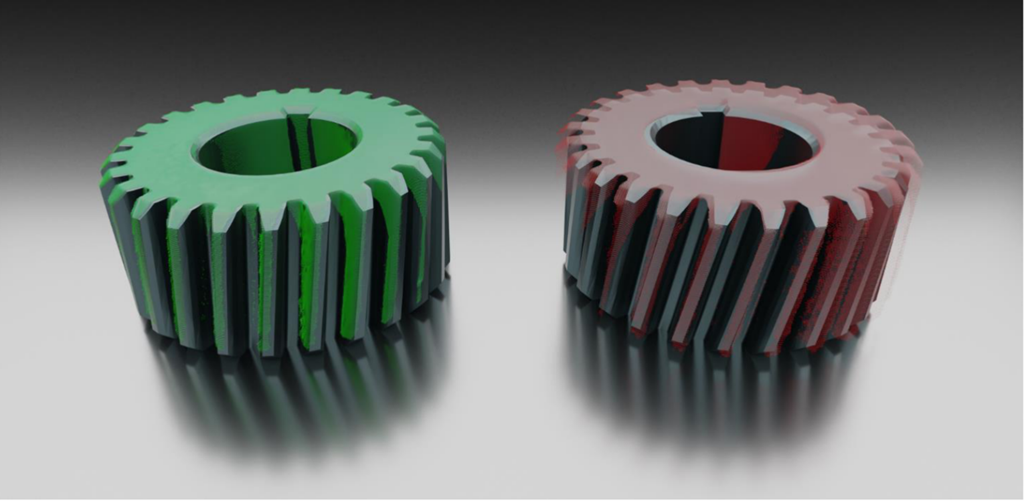
Precision&Trueness - Seeing the Details and Remaining True to Reality