.svg "Zivid")




Walk into any factory that has tried to automate bin picking of machined metal parts at the scale of a euro stillage, a deep tote stacked two layers high, or a 1.2-meter pallet box, and you will hear the same story. The cell runs beautifully on a small demo bin. Then production swaps in the real container, the stationary camera is sitting two meters above it, and the picks start going wrong. The robot grabs air. The gripper closes on what looked like a part edge but was a phantom surface stitched up by reflected light. The picks are not failing at the planner. They are failing because the point cloud arriving at the planner is a mess.
That mess has a name: interreflection artifacts. In a large bin of shiny metal parts, it is the single biggest reason your pilot does not make it to a 24/7 line.
Why shiny metal is harder to image in large bins
A structured-light 3D camera expects the projected pattern to bounce off the part and return cleanly to the sensor. Shiny machined surfaces do not oblige. Light hits one part, reflects onto another, reflects back to the sensor from a path the camera never modeled, and the triangulation engine reconstructs a point that does not exist.
Here you see an example of what a point cloud looks like with vs. without interreflections:
The interreflection physics are the same whether the bin is small or large or the camera is close or far. What changes when you scale up to a 1.2-meter pallet box is the camera’s ability to resolve and filter those artifacts. Covering a large bin from a single stationary mount puts fewer pixels on each shiny part than a small-bin setup would, whether you get there through longer working distance, wider field of view, or both. With fewer pixels per surface, artifact-removal filters have less data to discriminate phantom geometry from real surfaces. The interreflections themselves are not worse. The camera’s ability to resolve and filter them is.
Point cloud quality has to hold across the whole working volume
In a large bin, the area of interest moves as the cell runs. Top layer at the start of the shift, floor of the bin by the end. A camera that resolves the top beautifully and smears the bottom is no good when you are picking the last few parts at the bottom of a deep pallet box.
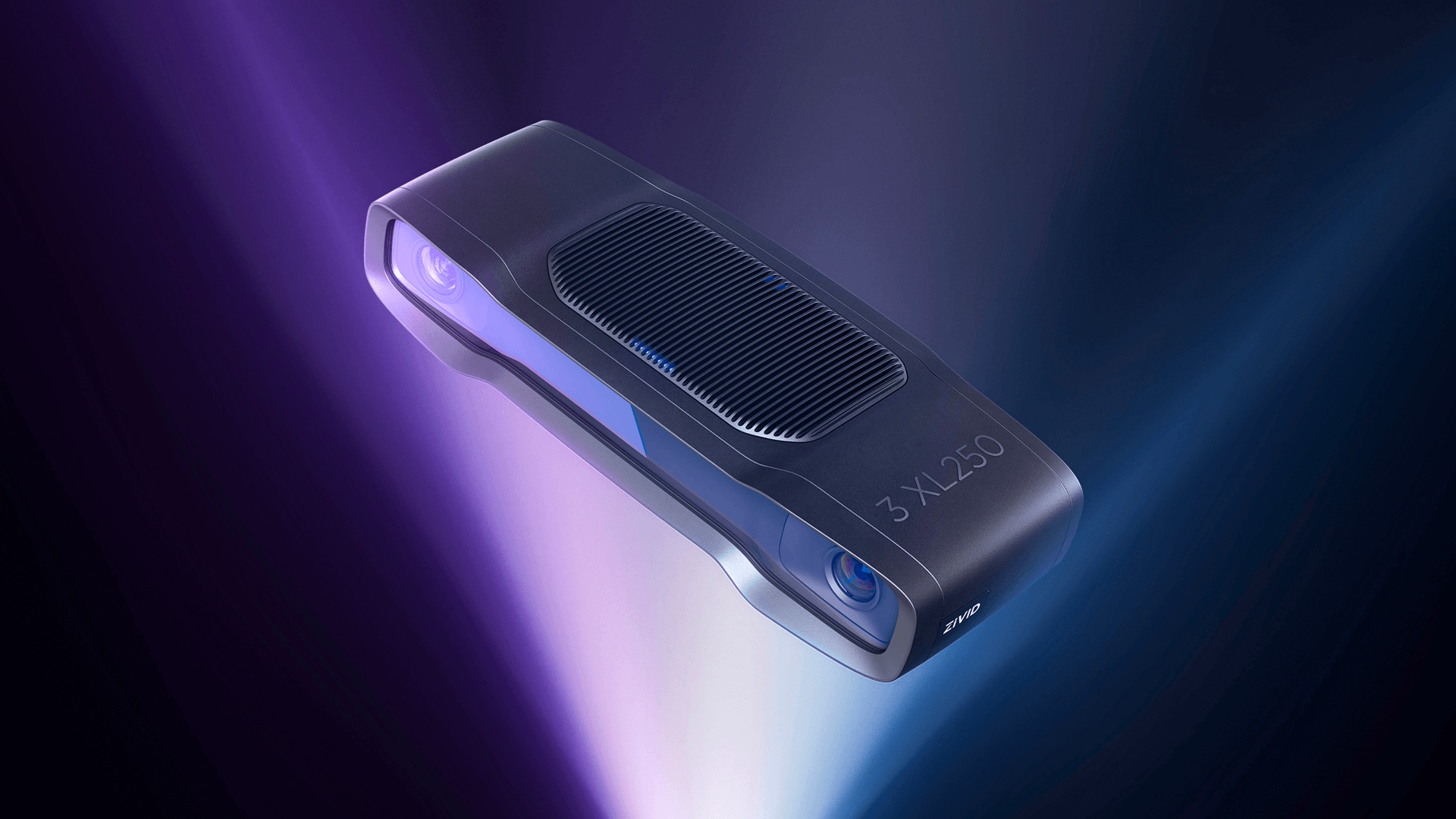
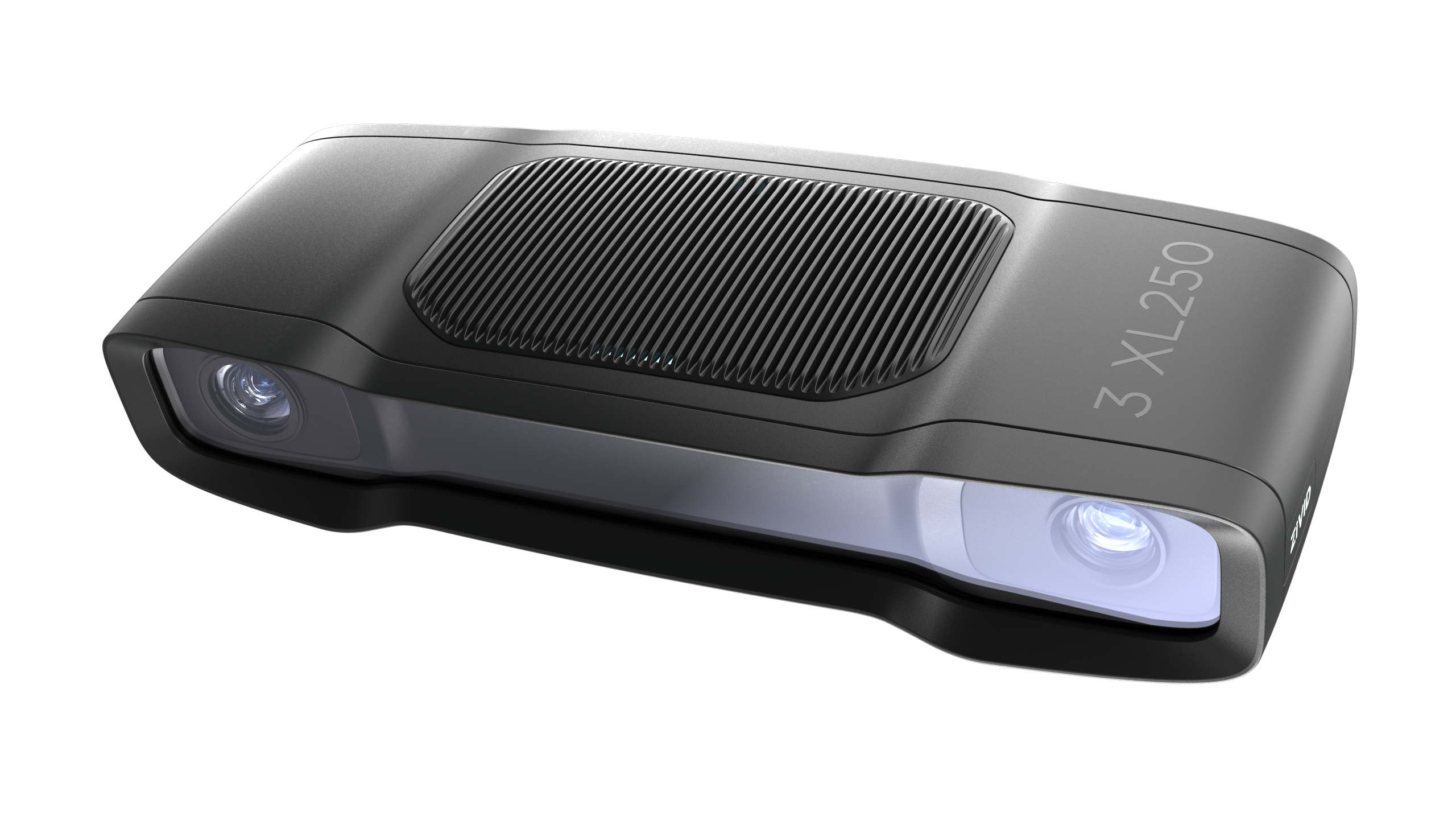
This is where working volume matters as much as raw working distance. Zivid 3 XL250 was built for this slot specifically: working range up to 4.5 meters, a field of view large enough to cover a 1.2 × 1.2 m pallet box from a stationary mount in its working range, and consistent point cloud quality from the top of the bin to the bottom. First pick to last, the geometry you hand the planner does not drift.
What you need from the camera for shiny metal at this scale
A point cloud that is correct (no false geometry from interreflections), complete (no holes where light specularly bounced away from the sensor), and clean (no flying pixels at the edges where a pose estimator will latch onto the wrong feature).
Zivid 3 XL250 hits this with HDR imaging across multiple exposures, a blue laser that is resilient to changing ambient lighting, and a stack of artifact-removal filters built specifically for interreflections on metallic surfaces. Capture on the trickiest shiny parts lands under 500 ms, comfortably inside the 5 to 10 second cycle time of a typical bin-picking robot. The camera never holds the arm up, even as the bin gets harder to image.
That combination matters even more in multi-bin layouts where a single stationary camera covers two or three bins. The wide-FOV, long-range setup that lets one camera cover multiple bins is exactly the setup that punishes weaker optics on shiny parts.
What good looks like
If you are benchmarking cameras for a large-bin shiny-metal project, test each candidate against your real bin at the working distance you will actually deploy at. Look at the raw cloud, not the rendered preview. Count the holes. Look for floating surfaces above the part faces. Check the edges. Then move the bin to the floor of the working volume and look again. The camera that gives you a clean cloud on the bottom layer at full reach is the camera that will not burn you in week ten on the customer’s line.
Want to see how Zivid 3 XL250 handles your large bin of shiny parts? Book a demo and we will capture your parts at your working distance:

Zivid 3 Sets a New Standard for Big Robots in Depalletization and Large Bin-Picking
The Best 3D Camera for Big Workloads in Factories and Warehouses